
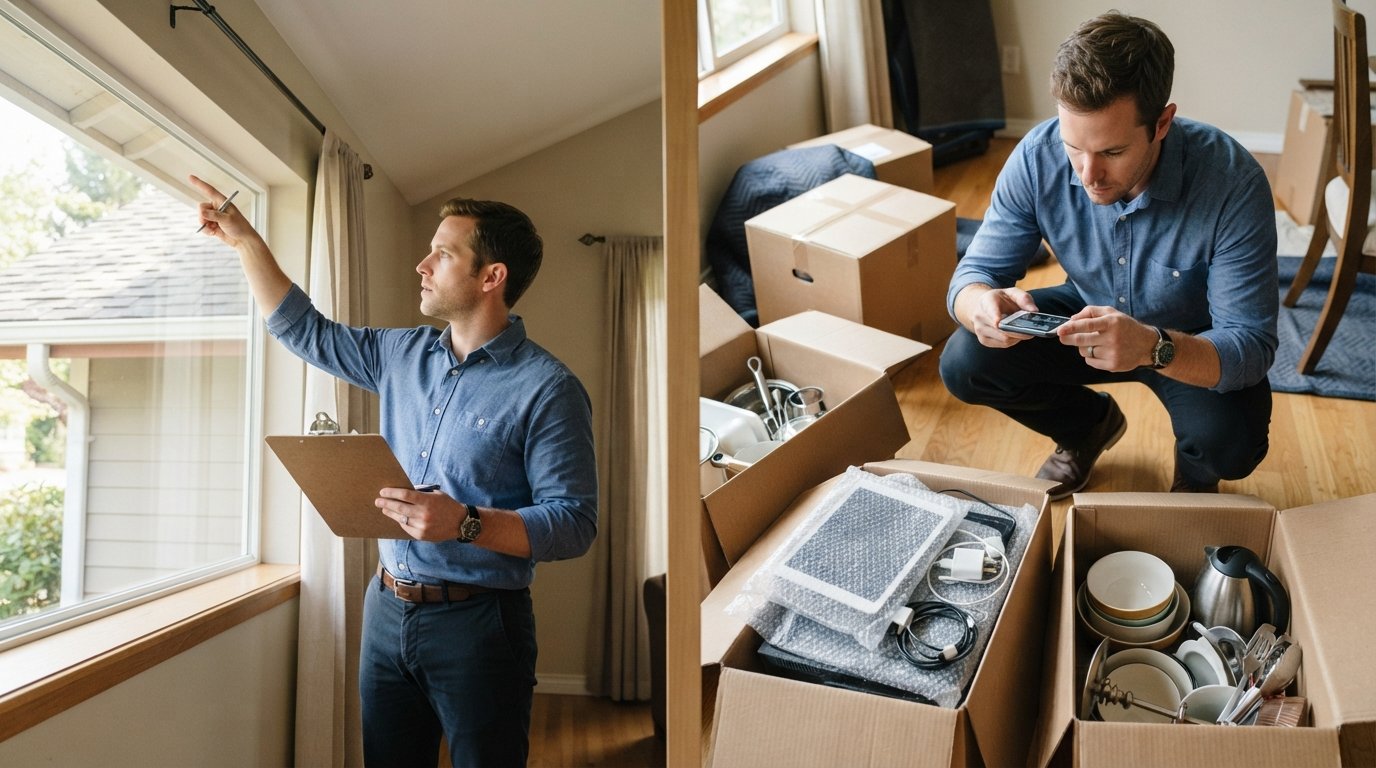
Personal Property vs Dwelling Coverage: Key Home Insurance Differences
Understand personal property vs dwelling coverage homeowners insurance so you can set limits that protect both your home and everything inside it.

By Maya Young
When you open your homeowners insurance policy, you will see two separate coverage lines that often get confused: dwelling coverage and personal property coverage. One protects the house itself, and the other protects the things inside it. Mixing them up can lead to costly gaps, especially after a fire, theft, or storm. Understanding how these coverages work together, and where they diverge, is essential for setting limits that actually protect your financial recovery.
Dwelling coverage (Coverage A) pays to repair or rebuild the physical structure of your home, including the roof, walls, floors, and built-in appliances. Personal property coverage (Coverage C) reimburses you for damaged or stolen belongings such as furniture, electronics, clothing, and kitchenware. The two are not interchangeable, and your policy sets separate limits for each. A common mistake is assuming a high dwelling limit automatically means your belongings are fully covered. In reality, personal property limits are usually a percentage of your dwelling coverage, often 50 to 70 percent, and that number may not reflect what it would cost to replace everything you own.
This guide breaks down the differences between personal property vs dwelling coverage homeowners insurance, explains how claim settlements work, and shows you how to inventory your belongings so you can choose limits that match your household. Along the way, you will see why reviewing both coverages together, rather than in isolation, gives you a more accurate picture of your financial exposure.
What Dwelling Coverage Protects and How Limits Are Set
Dwelling coverage is the foundation of your homeowners policy. It pays to repair or rebuild the structure of your home after a covered peril, such as fire, windstorm, hail, or vandalism. The limit is not based on your mortgage balance or the market value of your home. Instead, insurers typically calculate it using replacement cost estimates that factor in local construction costs, square footage, and features like custom cabinetry or hardwood floors. If your dwelling limit is too low, you could face a shortfall when rebuilding costs exceed what your policy pays.
Dwelling coverage also extends to structures attached to the house, such as an attached garage, a deck, or a porch. Detached structures like a shed or fence are usually covered under a separate "other structures" line, not dwelling coverage. Understanding these boundaries matters because a claim for a detached garage may fall under a different limit than a claim for the main house. When you review your policy, check that your dwelling limit reflects current rebuilding costs in your area, not what you paid for the home years ago.
Several factors influence how insurers set dwelling limits. Local labor rates, building code upgrades, and the cost of materials all play a role. Some policies include extended replacement cost coverage that pays beyond the stated limit, while others cap payouts at the limit. If you have made significant improvements, such as a kitchen remodel or an addition, you should update your dwelling coverage to reflect the increased replacement cost. Otherwise, you risk being underinsured for the very structure you rely on most.
How Personal Property Coverage Reimburses You for Belongings
Personal property coverage pays for the contents of your home, from sofas and beds to laptops, clothing, and dishes. Unlike dwelling coverage, which focuses on the structure, personal property coverage follows your belongings even when they are temporarily outside the home, such as luggage stolen from a hotel room or a laptop taken from a car. However, coverage away from home may be subject to lower limits or specific conditions. The core purpose is to reimburse you for the value of items that are damaged, destroyed, or stolen due to a covered peril.
The settlement method matters as much as the limit. Most standard policies start with actual cash value (ACV) for personal belongings, which means you receive the depreciated value of the item, not what it would cost to buy a new one. For example, a five-year-old television might be reimbursed at a fraction of its original price. Replacement cost coverage, by contrast, pays what it costs to buy a comparable new item today, up to your policy limit. Many insurers offer replacement cost coverage as an upgrade or endorsement, and it can make a significant difference in how much you receive after a claim.
To illustrate, imagine a kitchen fire destroys your cookware, small appliances, and a set of dishes. Under actual cash value, you might receive a few hundred dollars after depreciation. Under replacement cost, you could receive enough to buy new equivalents, minus your deductible. The difference can be thousands of dollars depending on what was lost. When comparing personal property vs dwelling coverage homeowners insurance, remember that dwelling coverage is often settled on a replacement cost basis, while personal property may default to ACV unless you specifically request replacement cost coverage.
- Actual cash value (ACV): Pays depreciated value; lower premiums but smaller payouts.
- Replacement cost (RC): Pays to replace items at today's prices; higher premiums but more complete recovery.
- Functional replacement cost: Pays for similar but less expensive materials or items; a middle ground for some policies.
Choosing between ACV and replacement cost for personal property is a budgeting decision. If your belongings are older or you could comfortably replace them gradually, ACV might be acceptable. If you have a household full of relatively new furniture and electronics, replacement cost coverage can prevent a major out-of-pocket hit after a loss. Always confirm which settlement method applies to your personal property coverage, and ask whether you can add replacement cost if it is not included.
Sub-Limits for High-Value Items Like Jewelry and Collectibles
Even if your personal property limit seems generous, sub-limits can cap how much you receive for specific categories of valuables. Standard homeowners policies commonly impose dollar limits for theft of jewelry, watches, furs, silverware, and firearms. For example, a policy might cap jewelry theft at $1,500 or $2,500, regardless of your overall personal property limit. Collectibles such as stamps, coins, or trading cards may also be subject to low sub-limits or excluded altogether. These caps exist because high-value, portable items are easier to steal and harder to value.
If you own expensive jewelry, art, or collectibles, relying on standard personal property coverage can leave you underinsured. The solution is often a scheduled personal property endorsement, also called a floater, which insures specific items at agreed-upon values without a deductible and typically covers risks beyond those in the base policy. You will need an appraisal or receipt for each item. Alternatively, you can increase the sub-limit through an endorsement, though that may be less precise than scheduling individual pieces.
Consider a household with a $5,000 engagement ring and a $3,000 watch. If the policy's jewelry theft sub-limit is $2,000, the homeowner could face a significant shortfall after a theft. Scheduling the ring and watch separately would provide full coverage up to their appraised values. The same logic applies to collectibles, musical instruments, and camera equipment. Review your personal property coverage with these high-value categories in mind, and document your valuables before a loss occurs.
Inventorying Belongings and Choosing Personal Property Limits
Choosing the right personal property limit starts with knowing what you own. Many homeowners underestimate the total value of their belongings, which can lead to underinsurance. A simple home inventory can solve this problem. Walk through each room, list items, note purchase dates and prices, and take photos or video. Store the inventory in the cloud or another location outside the home. This record serves two purposes: it helps you set an accurate personal property limit, and it supports your claim if you ever need to file one.
After completing the inventory, compare the total value to your policy's personal property limit. If your limit is 50 percent of your dwelling coverage and your dwelling is insured for $400,000, your personal property limit would be $200,000. For many households, that is sufficient, but for others, especially those with extensive electronics, tools, or collections, it may fall short. You can often increase the personal property limit for an additional premium. The goal is to align your limit with the replacement cost of your belongings, not just their depreciated value.
Here is a simple framework for choosing a personal property limit:
- Create a room-by-room inventory with photos, receipts, and estimated replacement costs.
- Total the replacement cost of all items, not their original purchase price.
- Compare the total to your policy's personal property limit and sub-limits.
- Adjust your limit or add scheduled endorsements for high-value items.
- Review annually or after major purchases to keep coverage current.
This process also helps you decide whether replacement cost coverage is worth the added premium. If your inventory shows a high concentration of newer items, replacement cost coverage may be a smart choice. If your belongings are older and you would replace them with less expensive alternatives, ACV might be adequate. The key is to make an informed decision rather than defaulting to whatever the policy includes.
Common Mistakes and How the Coverages Interact
One of the most common mistakes is assuming that dwelling coverage and personal property coverage are interchangeable. They are not. If a pipe bursts and damages your floors and furniture, dwelling coverage pays for the floors, and personal property coverage pays for the furniture, each subject to its own deductible and limit. A single deductible often applies to the entire claim, but the limits are separate. Understanding this division helps you set both limits appropriately and avoid gaps.
Another mistake is neglecting to update coverage after a major purchase or home renovation. If you buy expensive furniture or electronics, your personal property limit may no longer be adequate. Similarly, if you finish a basement or add a room, your dwelling coverage may need an increase. An annual policy review, ideally with a licensed agent, can catch these issues before a loss occurs. You can also use comparison tools to see how different insurers structure dwelling and personal property limits, which can help you find a policy that fits your household's needs.
For homeowners in disaster-prone areas, it is also worth understanding how natural disasters affect both coverages. Standard policies may exclude floods and earthquakes, requiring separate coverage. If you are unsure whether your policy covers a specific peril, check the exclusions section or ask your agent. For a deeper look at how disasters interact with homeowners insurance, see our guide on whether homeowners insurance covers natural disasters. Knowing these details helps you coordinate dwelling and personal property coverage without surprises.
Finally, remember that personal property coverage follows your belongings when you travel, but with limits. If you regularly carry expensive items, such as a laptop or camera, consider whether your policy's off-premises coverage is sufficient. Some policies reduce limits for items away from home, and theft from a vehicle may be excluded or capped. A quick review of these provisions can prevent a denied claim when you least expect it.
Coordinating Dwelling and Personal Property Coverage for Full Protection
The best way to protect your home and belongings is to treat dwelling and personal property coverage as two parts of a single strategy. Start with an accurate rebuilding cost estimate for your home, then build a personal property limit that reflects the replacement cost of your belongings. Account for sub-limits on jewelry, collectibles, and other high-value items by scheduling them separately. Choose a settlement method (ACV or replacement cost) that matches your budget and your willingness to replace items after a loss. And review everything annually, because your home and your belongings change over time.
When you are ready to compare policies, use a resource that lets you see how different insurers handle dwelling limits, personal property limits, and endorsements. QuoteComparison offers tools and educational content to help you compare homeowners insurance options side by side, so you can make an informed decision about both coverages. Whether you are buying your first home or updating an existing policy, understanding personal property vs dwelling coverage homeowners insurance is a foundational step toward financial peace of mind.